
So you’ve got an app idea. Maybe it’s been keeping you up at night, or perhaps your business needs one to stay competitive. Either way, the first question that hits you is always the same: What’s this going to cost me?
There’s no magic number. No developer can give you an exact price without understanding what you’re building. That’s what makes app development both exciting and slightly terrifying for founders.
This guide exists to remove the guesswork. We’re not here to sell you dreams or make hazy estimates. Rather, we’ll dissect the actual elements that influence your app development cost in Canada. Think of it as your roadmap to smarter spending.
Your mobile app development cost isn’t just about hiring developers. It’s influenced by whether you’re going iOS, Android, or cross-platform. Your feature complexity, design needs, and third-party integration affect it. The price changes with each choice.
This guide is for enterprises planning advanced solutions, SMBs scaling digitally, and startups testing their first idea. Are you a founder trying to stay on budget without cutting corners? You’re in the right place.
Let’s get practical about what building an app actually costs in Canada.
How Mobile App Development Costs Are Estimated (Key Factors)
Before any developer quotes you a price, they’re running through a mental checklist. It’s not random guesswork. Every app is a puzzle, and the cost depends on how many pieces you need to fit together.
It’s like building a house. A studio apartment costs less than a mansion. But both need foundations, walls, and electricity. Apps work exactly the same way. The difference? What you’re building and how you choose to build it. Let’s break down what actually drives your budget.
App Complexity & Feature Set
This is where costs jump around the most.
A simple MVP (Minimum Viable Product) with basic features runs you $25,000 to $50,000. You get login, user profiles, and one main function. That’s it. You’re building lean, testing fast, proving your idea works.
Standard business apps add more layers. Payment gateways. Push notifications. Analytics dashboards. E-commerce features. None of these are wildly complex on their own. But they add up fast. You’re looking at $50,000 to $150,000 hkere.
Advanced features? That’s a different ballgame. Real-time chat. AI recommendations. Blockchain or custom backend systems. These push you past $150,000 easily. Why? They need specialized developers and massive time investments.
Platform Choice
Where your app lives changes what you pay. Native iOS apps use Swift. They’re built just for iPhones. Super polished and great performance. But you only reach Apple users.
Native Android apps use Kotlin or Java. You reach way more users worldwide. But here’s the catch. You need separate development from iOS. Building both? You’re paying double.
React Native and Flutter are examples of cross-platform tools that change the game. You save 30-40% compared to building native twice. Sure, there are small performance trade-offs. But most business apps won’t notice.
Working with a custom mobile app development company helps here. They’ll find the best platform for your needs and budget.
Design, UX/UI, & Prototype Costs
Good design isn’t just pretty colors. It’s how your app actually works. Wireframes and prototypes come first. Think of them as blueprints. They map out how users move through your app. They catch problems before a single line of code gets written. Plan for $5,000 to $15,000 here.
Full UI/UX design is where things get visual. Colors and animations. Button placements. Every tap and swipe. This runs $10,000 to $40,000 based on complexity.
Testing, QA & Maintenance
Building your app is only half the story.
Quality assurance catches bugs before your users do. Different devices. Different screen sizes and different Android versions. Good QA costs about 15-20% of your development budget. Skip this step and you’ll regret it. Users will find those bugs for you. They’ll leave one-star reviews instead.
Post-launch maintenance keeps your app alive. Budget 15-20% of your initial cost annually for this. Apps aren’t like websites. You can’t just launch and forget them. They need regular care and feeding.
Cost Ranges for Canadian Mobile App Development

Let’s be more precise. Numbers, not theory, are what you want. This is the current cost of app development in Canada, broken down by the type of app you’re creating.
These don’t just come out of nowhere. These ranges were based on the real projects, schedules, and budgets of Canadian development teams. These numbers are a good place to start when making plans, but the actual cost may be different based on your needs.
Simple/Inexpensive App Cost
The price range is between CAD 10,000 and CAD 40,000.
Timeframe: two to four months
These are the apps you should start with. They do the job, but it’s nothing special.
What you receive:
✓ Simple information display (apps for digital brochures)
✓ Basic utility tools or calculators, minimal interaction with static content
✓ Simple user interface utilizing pre-made templates
✓ Minimal backend, primarily front-end
✓ No intricate third-party services or integrations
Ideal for rapidly testing concepts. This isn’t the place to build the next Uber. This stage confirms if your offering is truly desired by the public. Don’t make it too big. Launch quickly. Learn more quickly.
Typical Price of a Business App
CAD 40,000 to CAD 80,000 is the price range.
Timeframe: three to six months
This is where most businesses land. You need more than just information display; you need actual functionality.
What you usually include:
- Systems for user registration and login
- Push notifications for user engagement
- Integration of payment gateways (Paypal, Stripe)
- API connections to your current systems
- Simple admin dashboard
- Database administration
- Integration of social media
- In-app analytics
If you’re going native for just one platform, the Android app development cost in this range is typically a little less than the iOS app. In the center of this range is cross-platform development.
Creating a grocery delivery app of some sort? Here, you’re looking at the upscale. Product catalogs must be created. Coding is required for cart systems. GPS integration is necessary for delivery tracking. Processing payments adds another level of complexity. You get closer to that $80,000 threshold as a result of everything.
This tier is appropriate for well-established companies that are prepared to provide digital customer service. Product-market fit is what you have. The app is now required to scale it.
Cost of an Advanced/Feature-Rich App
The price range is between CAD 80,000 and CAD 150,000+.
Timeframe: six to ten months, occasionally more
These platforms are highly advanced. Not only applications. The reason for their high cost:
- Real-time capabilities (notifications, chat, and live updates)
- Custom architecture and intricate backends
- Integration of GPS and mapping
- On-demand service matching (for drivers, riders, and providers)
- AI or machine learning functionalities
- Video streaming or conferencing
- High-level security and encryption
- Complex data processing
- Third-party service integrations (many APIs)
This is where social networks belong. Dating apps as well. Marketplaces that operate on demand. Fintech solutions and platforms for healthcare. These are not fast builds. They need serious infrastructure, specialized developers, and a lot of testing in situations you haven’t even considered yet.
In this tier, scalability raises costs. Thousands of users must be supported simultaneously by your backend without experiencing any crashes. Massive growth must be supported by the database structure. Sensitive user data must be protected from all sides by security protocols.
These ranges are based on the assumption that you are collaborating with Canadian agencies or developers. Costs can be reduced by 40–60% with offshore teams, but project management complexity is sacrificed. Select the option that best suits your communication style and risk tolerance.
iOS App Development Cost in Canada
iOS apps live in a premium ecosystem. Apple users spend more. They engage more. They expect more polish. That expectation shapes everything about iOS development costs.
Building for iPhone means playing by Apple’s strict rules. The bar is higher. But so is the potential return on investment.
What iOS Development Includes
Apple’s ecosystem is strong but closed. Swift and Objective-C are the two programming languages that developers use to make apps that only work on iPhones and iPads.
This is what you’re getting for your money:
✓ Native iOS performance and smooth animations
✓ Access to Apple-specific features (Face ID, Apple Pay, HealthKit)
✓ Compliance with strict App Store guidelines
✓ Optimization for multiple iPhone screen sizes
✓ iPad compatibility considerations
✓ Integration with Apple services and APIs
Getting approval from the App Store is hard. Apple looks at every submission manually. They turn down apps because of problems with their design, functionality, or following the rules. This means more polish upfront. Developers need to build it right the first time. That impacts your mobile app development cost from day one.
Working with a SaaS app development company that understands Apple’s ecosystem saves you headaches. You avoid costly rejection cycles and endless revision rounds.
Cost Ranges for iOS Apps
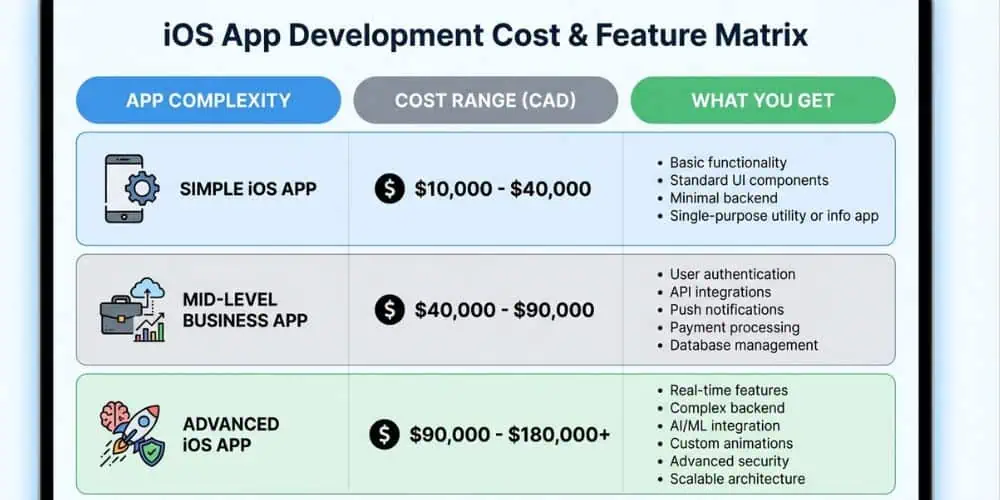
Let’s break down what iOS development actually costs across different levels. Your app’s features determine where you land in these ranges. More features mean more development time. More testing. Higher costs.
Simple apps sit at the lower end. Think calculators, portfolios, or basic service apps. Limited user interaction keeps costs down. Mid-level apps handle real business needs. E-commerce platforms. Booking systems. Customer portals. These require backend infrastructure and third-party integrations.
Advanced apps compete with market leaders. They need custom everything. Performance optimization for thousands of users. Security that protects sensitive data. Features that set you apart completely.
Timeline, Testing & App Store Fees
There is a close relationship between development timelines and cost ranges.
It takes 2 to 4 months to make and launch a simple iOS app. Mid-level apps may need 3 to 6 months. Advanced applications stretch to 6 to 12 months or beyond.
Testing on iOS means checking across multiple iPhone models. iPhone SE users see different screens than iPhone 15 Pro Max users. Your app needs to work beautifully on all of them.
Apple charges $99 USD annually for a Developer account. Small fee. Mandatory though. No account means no App Store presence. Budget this into your recurring costs.
App Store review takes 24 to 48 hours, typically. Rejections happen, though. Each rejection adds days or weeks, depending on what needs fixing. First-time submissions are often turned down for small mistakes in the rules. Make sure you have time for at least one round of changes.
Android App Development Cost in Canada
Android dominates the global market share. Over 70% of smartphones worldwide run Android. That’s a massive audience you can reach.
But here’s the catch. Android means fragmentation. Thousands of different devices. Multiple OS versions running simultaneously. Screen sizes range from tiny budget phones to massive tablets.
This diversity shapes your development costs. More testing and optimization. More complexity to manage.
What Android Development Includes
Android development uses Kotlin or Java. Apps work on everything from high-end Samsung phones to low-cost phones from many different companies.
This is what makes your investment:
✓ Development for different screen sizes and resolutions
✓ Testing on different versions of Android OS (from Android 9 to 14+)
✓ Optimizing for different hardware capabilities
✓ Following the rules of the Google Play Store
✓ Using Material Design guidelines
✓ Fixing bugs and making changes that are specific to each device
It’s true that fragmentation happens. Your app might work fine on a Samsung Galaxy but crash on a OnePlus phone. Different companies make Android work in different ways. They add their own layers to the UI. Some block certain features. Some companies handle permissions in their own way.
This means more hours of QA. Test more devices. There are more edge cases to deal with. Compared to iOS’s controlled environment, all of this adds time and money to your project.
Cost Ranges for Android Apps
Android development costs often run slightly lower than iOS for comparable features. Why? Larger developer pool. More competition. Slightly less stringent design requirements.
Here’s what you can expect to invest across different complexity levels.
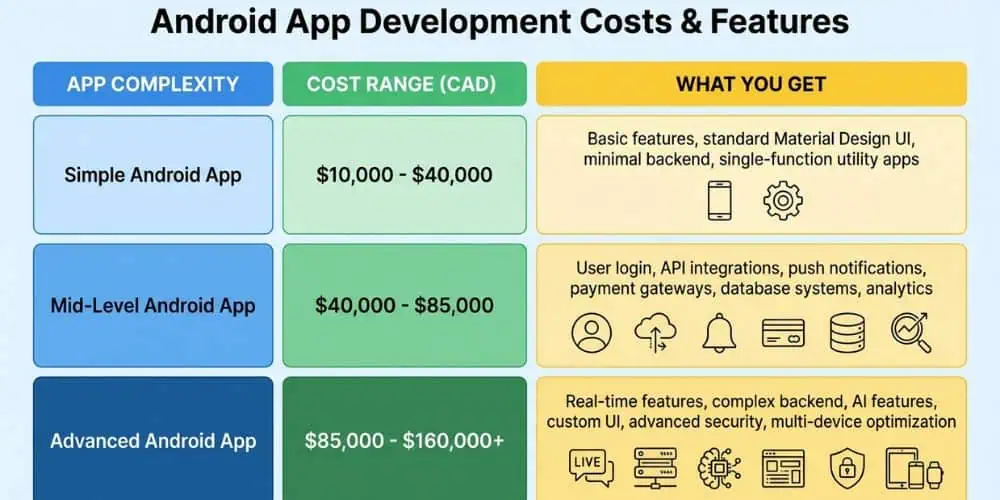
Simple apps cover basic needs. Information apps. Simple tools. Straightforward interfaces with limited user interaction. Mid-level apps power real businesses. E-commerce stores. Delivery platforms. Service booking apps. These need solid backends and payment processing.
Advanced apps compete at scale. Social platforms and on-demand marketplaces are fine examples. Fintech solutions too. They handle thousands of concurrent users without breaking a sweat.
The beauty of Android? You reach users globally. Emerging markets run predominantly on Android. If international expansion matters to your business model, Android opens doors iOS can’t.
Timeline, Testing & Play Store Fees
Development timelines align closely with iOS. Simple Android apps take 2 to 4 months. Mid-level apps need 3 to 6 months. Advanced applications require 6 to 12 months minimum.
Testing is where Android gets tricky. You can’t test on every device. There are thousands. Instead, developers test on representative devices covering different manufacturers, screen sizes, and OS versions. Budget Samsung or Flagship Google Pixel. Popular OnePlus models. They test the app on different makes and models.
Every device might act in a different way. A notification that works on Samsung might not work on Xiaomi. Permissions that work well on stock Android might not work at all on custom ROMs.
Google Play Console costs just $25. One-time fee. Forever access. Way cheaper than Apple’s annual $99 charge. Upload unlimited apps to the store without recurring fees.
Play Store review is faster and more lenient than App Store. Most apps are approved in a few hours. Unless you break clear rules about content, privacy, or security, you won’t get rejected very often. Almost right away after submission, updates go live.
Hidden & Recurring Costs You Must Budget For
Launch day isn’t the finish line. Many founders think the hard part ends when their app goes live. That’s when the real work actually begins.
Apps need ongoing investment to stay alive, secure, and competitive. If you’re not ready, these costs that come up again and again can catch you off guard. Let’s talk about what you’ll really have to pay after the first build.
App Maintenance (Annual): 15% to 20% of Initial Cost
Your app needs regular care to survive. Operating systems update constantly. iOS releases major updates every year. Android does the same. Each update can break features in your app.
Bug fixes pop up after launch. Users discover issues you never saw in testing. Performance problems emerge under real-world usage. Security vulnerabilities get discovered and need patching immediately.
New devices hit the market constantly. Foldable phones arrive. Screen sizes change. Hardware capabilities evolve. Your app needs optimization for each one to maintain a good user experience.
You may budget 10% to 20% of your mobile app development cost annually for maintenance. Skip this and your app becomes outdated, buggy, and eventually unusable.
Hosting, Cloud Services, and Backend Infrastructure
Your app’s data lives somewhere. That somewhere costs money every month.
Cloud hosting through AWS, Google Cloud, or Azure scales with your users. Small user base costs you $50 to $200 monthly. Growing user base jumps to $500 to $2,000 monthly or higher.
Database storage grows as your users create content. File storage adds up if users upload photos or documents. Video streaming or high-resolution images eat bandwidth fast. These costs scale with success. More people using the service means higher infrastructure costs. Make sure to include this growth in your budget plans.
API Subscriptions, Push Notifications, and Analytics
Third-party services power modern app features. Each one charges fees.
Push notification services like OneSignal or Firebase offer free tiers for small user bases. Beyond that, you pay $10 to $100+ monthly based on volume. Sending millions of notifications gets expensive quickly.
Payment processing takes a cut too. Stripe charges 2.9% plus $0.30 per transaction. PayPal has similar rates. High transaction volume means significant monthly fees adding up.
Tools for analytics keep track of how users act. It’s free to use Google Analytics, but it has some limits. Depending on the amount of data and features, advanced platforms like Mixpanel or Amplitude charge between $25 and $300 per month.
Ongoing Updates for OS Compatibility
Apple and Google update their platforms on their own schedule. They don’t ask your permission first.
iOS 18 might deprecate features your app relies on. Android 15 could introduce new permission requirements. Your app needs updates to stay compliant and functional.
App Store guidelines change regularly too. Apple updates review policies often. Features allowed last year might get flagged this year. Staying compliant requires ongoing development work.
Users expect new features over time. Competitors keep improving their apps. Standing still means falling behind. Feature updates keep your app relevant and competitive in the market.
Similar to managing website development cost, app development requires thinking long-term about ongoing expenses, not just the initial build.
Getting Started With Your App Development
Building an app doesn’t have to overwhelm you. You now know what drives costs. You understand what to expect at each complexity level. You’ve seen the hidden expenses to plan for.
We help businesses make their app ideas come true. We make iOS, Android, and cross-platform apps that solve real business problems, from the first strategy to the launch and beyond. Our company works with startups. Businesses that are scaling up complex platforms trust us, too.
Ready to discuss your app project? Let’s talk about what you’re building with MM Nova Tech and create a realistic roadmap that fits your vision and budget.